Skip to content

Deep-tech cognitive architecture

Building Cognitive Infrastructure Beyond Traditional AI

Carbonyx AI develops Aerius, a cognitive architecture that separates memory, reasoning, observation, identity, knowledge, and evidence into inspectable runtimes around artificial intelligence systems.

AeriusAerius Cognitive Runtime

Aerius Runtime Overview

Inspectable cognitive modules coordinated around model execution.

Evidence Driven

01

IISL

02

COR

03

CCO

04

PbR

05

COMS

06

Intent Action

Central Cognitive Orchestrator

Coordinates cognitive modules, policy gates, and evidence records around base models and external systems.

PolicyTraceEvidence

Architectural limits

Traditional AI systems hit limits when the model is treated as the entire system.

Large models are powerful, but real-world AI systems need structure around them: durable memory, governed observation, domain protocols, traceability, and reasoning control.

01

Memory needs structure

Context windows are not governed memory. Durable AI systems need provenance, versioning, retrieval policy, and evidence-aware recall.

02

Reasoning needs orchestration

A single model call cannot manage every reasoning path. Complex tasks need prioritization, resource control, and risk-aware routing.

03

Observation needs governance

Observation should be controlled by intent, evidence need, risk, and resource limits instead of indiscriminate data intake.

04

Knowledge needs operationalization

Domain knowledge needs to become operational reasoning structure, not passive text added to a prompt.

05

Decisions need evidence

AI-supported outputs need traceability: what evidence was used, what gates applied, and how the result was produced.

Aerius Cognitive Architecture

Aerius separates cognitive functions into specialized, inspectable runtimes.

Instead of asking a single model to perform every function, Aerius coordinates specialized cognitive runtimes around the model.

Aerius

Aerius is not a single model. It is an architecture that can sit around models, tools, memory stores, document systems, sensors, and domain runtimes.

Its purpose is to make AI systems more structured, auditable, context-aware, resource-aware, domain-adaptable, and governed by evidence and policy.

Observation Runtime

Reasoning Runtime

Memory Runtime

Identity Runtime

01

User / Environment / Data Sources

02

IISL / COR - Observation and Context Formation

03

CCO - Central Cognitive Orchestrator

04

PbR / Stack Brain - Reasoning Control

05

Memory & Knowledge Systems

06

Trace / Evidence / Policy Gates

07

Response / Action / Human Review

Core technologies

A modular architecture portfolio for memory, reasoning, observation, knowledge, and traceability.

The Aerius architecture is organized as interoperable cognitive layers, each focused on a specific architectural responsibility.

IISL

Intelligent Interface and Sensor Layer

Input and context formation layer

Normalizes documents, streams, APIs, sensors, media, and external search into structured observation envelopes.

COR

Cognitive Observation Runtime

Intent-driven perception governance

Controls what to observe, from which source, at what resolution, and under which evidence requirement.

CCO

Central Cognitive Orchestrator

Cognitive coordination layer

Directs memory, reasoning, observation, policy-aware processing, tools, and trace records across specialized modules.

PbR

Priority-Based Reasoning

Reasoning priority and resource control

Manages importance, urgency, confidence, risk, compute budget, latency, and expected utility.

StackBrain

Aerius Stack Brain

Multi-stack cognitive orchestration

Coordinates multiple reasoning stacks inside a shared decision window for specialized, inspectable cognitive paths.

COMS

Cognitive Orchestrated Memory System

Tiered cognitive memory

Provides tiered, evidence-aware, versioned, and deterministic memory retrieval under explicit policies.

IMC / RCC

Identity and Relational Cognition

Identity-bound memory

Maintains structured memory around people, entities, preferences, roles, trust, boundaries, and context over time.

KEL

Knowledge Evolution Layer

Human-driven knowledge evolution

Extracts, structures, validates, promotes, quarantines, and governs human-derived knowledge.

DCR

Domain Capsule Runtime

Domain-specific cognitive runtime

Transforms domain knowledge from passive text into loadable, governed reasoning protocols.

CEA

Cognitive-Emotional Architecture

Expression and state alignment

Aligns affective state, expression intent, safety envelopes, and response shaping with cognitive reasoning.

CPOR

Conditional Processing Outcome Reuse

Reusable cognitive results

Reuses prior cognitive outputs only when task, context, evidence, time, policy, and risk conditions match.

Intent Action

Intent-Driven Action System

Governed intent-to-action runtime

Converts cognitive intent into digital or physical action plans under policy, role, safety, and human-review constraints.

Technical IP portfolio

A patent-document portfolio covering multiple layers of cognitive AI architecture.

Carbonyx AI's architecture is supported by a technical IP portfolio spanning cognitive memory, reasoning orchestration, observation runtime, identity, knowledge evolution, domain capsules, conditional reuse, and governed action.

Portfolio stance

Designed to protect a layered cognitive architecture, not a single application surface.

The Carbonyx AI portfolio frames memory, reasoning, observation, identity, knowledge, action, expression, and traceability as architecture-level systems.

Portfolio Summary

15 Technical IP Documents

Core Areas

MemoryReasoningObservationIdentityKnowledgeActionExpressionMeta Reasoning

Status

Patent FilingsTechnical DisclosuresResearch Documents

Use technical IP portfolio, patent-document portfolio, or patent filings and technical disclosures unless granted status is explicitly confirmed.

01

Hybrid Cognitive Orchestrator Architecture

A foundational architecture for coordinating memory, reasoning, identity, evidence promotion, and self-learning across hybrid AI systems.

02

COMS - Multi-Modal Tiered Memory

A tiered memory architecture for deterministic retrieval, evidence-driven promotion, versioning, as-of views, and orchestrated reasoning support.

03

PbR - Priority-Based Reasoning

A mechanism for prioritizing reasoning, allocating resources, controlling cognitive rhythm, and managing risk, urgency, confidence, and utility.

04

CEA - Cognitive-Emotional Architecture

A cognitive-affective architecture for managing state, expression, ethics, uncertainty, and continuity in AI communication.

05

IISL - Intelligent Interface and Sensor Layer

A multi-modal interface and sensor layer for intake, normalization, provenance, event processing, and deterministic context formation.

06

Voice / Expression Orchestration

A system for coordinating AI expression across voice, gaze, facial expression, and gestures according to cognitive intent and state.

07

Intent-Driven Physical Action

A system for converting cognitive intent into governed physical or digital action under safety, context, and policy constraints.

08

IMC - Identity-Bound Memory

An identity-bound memory system for maintaining context, entity memory, preferences, roles, and continuity across time.

09

CPOR - Conditional Processing Outcome Reuse

A mechanism for reusing previous cognitive results only when task, context, evidence, time, and policy conditions allow reuse.

10

KEL - Human-Driven Knowledge Evolution Layer

A layer for extracting, structuring, validating, promoting, demoting, quarantining, and governing human-derived knowledge.

11

MRMI - Meta-Reasoning and Meta-Innovation

A meta-layer for selecting, evaluating, improving, and governing reasoning strategies without retraining the base model.

12

Aerius Stack Brain

A stack-based cognitive architecture for coordinating multiple reasoning stacks, meta-level control, synchronization, and adaptive cognitive processing.

13

DCR - Domain Capsule Runtime

A domain capsule runtime for loading, validating, binding, and governing domain-specific reasoning protocols inside AI reasoning systems.

14

COR - Cognitive Observation Runtime

A runtime for controlling perception and observation according to intent, evidence need, risk, resource budget, and governance policy.

15

RCC - Relational Cognition Core

A relationship-aware cognition layer extending identity memory with trust, safety, attachment, familiarity, boundaries, and predictive relationship modeling.

Demonstrations

Demonstrating Cognitive Architecture in Practice

Aerius demonstrations are designed to show runtime flow, traceability, evidence structures, and governed cognitive processing that conventional chat interfaces usually hide.

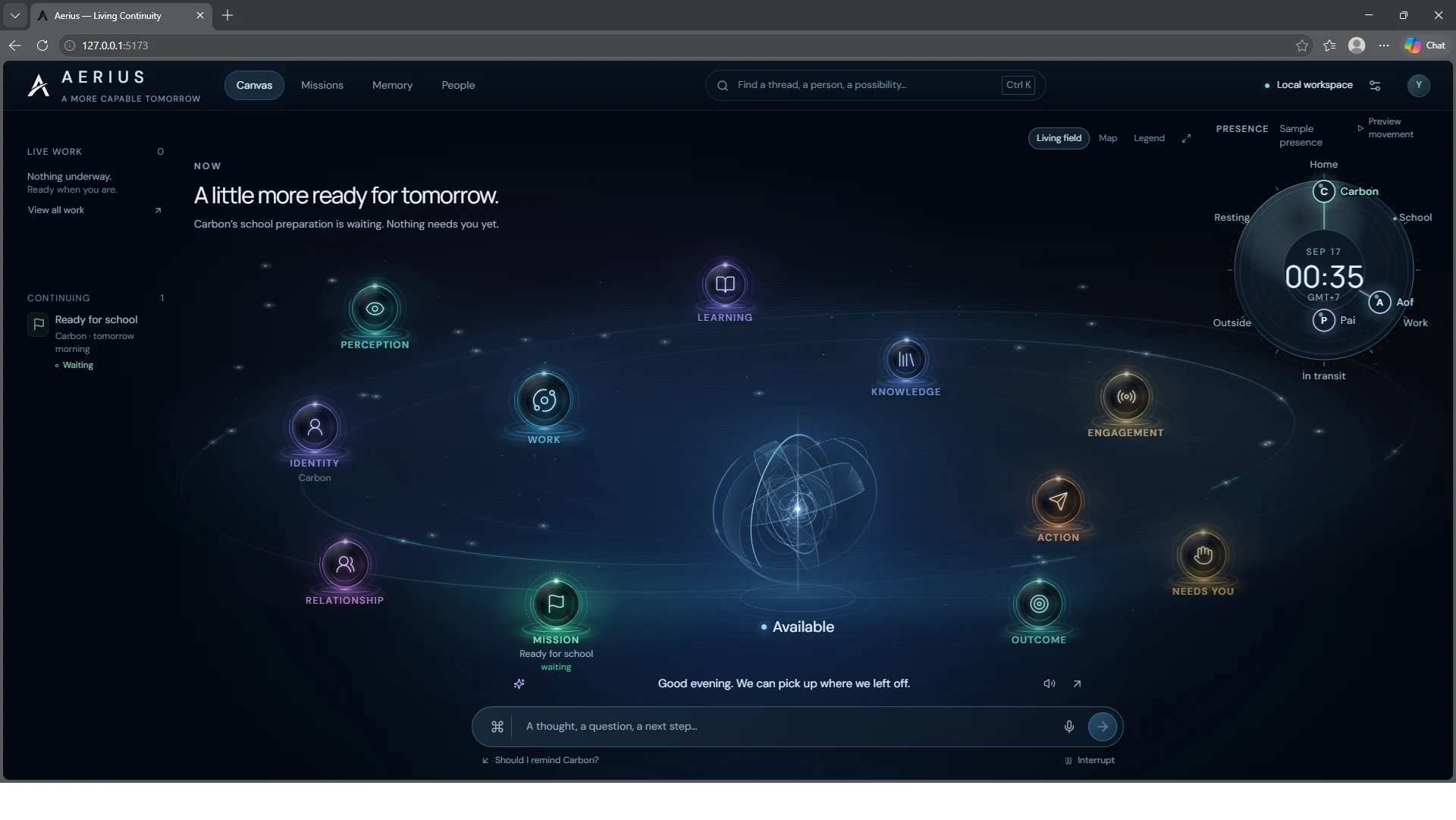
Aerius Interactive Demo

Shows how the system works beyond prompt-and-response interaction, with visible runtime behavior and cognitive module flow.

Trace & Evidence View

Surfaces trace records, evidence trails, policy gates, and runtime flow so outputs can be inspected instead of treated as opaque.

Cognitive Runtime Explorer

Explains how IISL, COR, CCO, PbR, COMS, and Intent Action connect inside the Aerius cognitive runtime.

Application domains

Designed for high-accountability domains where memory, evidence, and governance matter.

Aerius can be applied to domains that need traceable workflow assistance, structured context, domain-aware reasoning, and human review where appropriate.

Clinical & Medical Workflows

Evidence organization, patient-context continuity, risk-aware reasoning, and traceable workflow support under human oversight.

Education

Learning continuity, student context, adaptive guidance, and teacher support without reducing education to one-off answers.

Enterprise Knowledge

Policy-aware retrieval, document reasoning, traceable summaries, and evidence-backed internal decision support.

Regulated Operations

Policy-aware review, document assistance, evidence traceability, and human-review workflows for high-accountability environments.

Robotics and Assisted Operations

Governed intent-to-action planning, observation coordination, policy gates, and traceable action support for supervised systems.

Industrial and Field Observation

Targeted observation, multi-modal inspection, evidence capture, risk-based escalation, and resource-aware sensing.

Company vision

AI progress will require architecture around models, not only larger models.

Carbonyx AI develops cognitive infrastructure that separates memory, observation, reasoning, identity, and action into inspectable runtime systems surrounding AI models.

Deterministic Memory Systems

Priority-Governed Reasoning

Evidence-Driven Observation

Domain Cognitive Runtimes

15 Technical IP Documents

12 Architecture Modules

1 Cognitive Runtime Framework

Contact

Contact Carbonyx AI for investment, partnership, research, and institutional inquiries.

Initial inquiries are handled through email while the public website remains focused on technical documentation and architecture information.

Inquiry types

InvestmentStrategic PartnershipResearch CollaborationEducationEnterprise

Contact Carbonyx AI

For investment, partnership, research, or institutional discussions related to the Aerius architecture portfolio.