01
A MODEL INSTANCE
The next response.
Interprets the current input and generates a useful continuation.
- Current prompt
- Available context
- Generated response
BUILT DIFFERENTLY
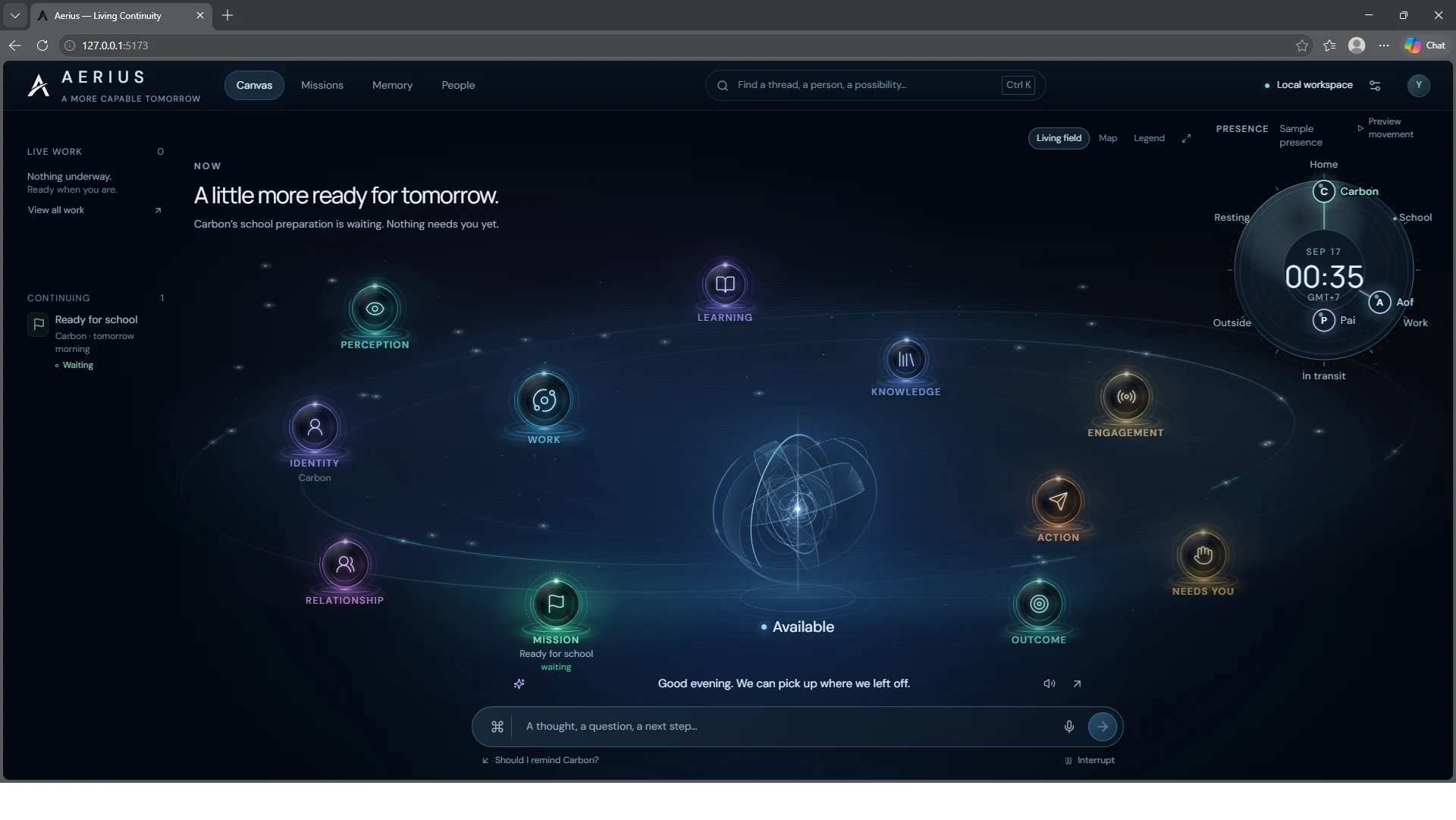
Aerius is designed as a system of specialized cognitive capabilities that work together across time—supporting memory, reasoning, perception, ongoing work, identity, and governed action.
Explore the system
A SYSTEM BUILT FOR CONTINUITY
01SYSTEM, NOT SESSION
A model can generate what comes next. A continuing AI experience needs more around it.
Context changes as people, work, and priorities move forward. Aerius is designed to maintain the broader state needed to understand that change over time.
The aim is not simply a longer conversation. It is an experience that can reconnect relevant memory, relationships, evidence, and unfinished work when they matter again.
A MODEL INSTANCE
Interprets the current input and generates a useful continuation.
A BROADER SYSTEM
Coordinates distinct responsibilities around the model so meaning and work can develop across time.
02SYSTEM FOUNDATIONS
These are public architectural principles. They describe how the broader system is designed to support the Aerius experience without restating its full capability model.
Meaningful state can continue.
The system is designed to carry meaningful context forward across time, without treating every interaction as a blank slate or every earlier detail as equally relevant.
CONTEXT / CHANGE / RELEVANCEMemory is context, not automatic proof.
Remembered information is designed to remain connected to meaning, origin, uncertainty, and relevance rather than being treated as settled truth simply because it was retained.
MEANING / ORIGIN / QUALIFICATIONDifferent problems may need different approaches.
The foundation is designed to support reasoning approaches that can suit the question, context, available knowledge, and level of evidence involved.
QUESTION / METHOD / JUDGMENTPeople and relational context are structured context.
People, roles, relationships, and boundaries are designed to remain meaningful system context as circumstances and interaction change over time.
IDENTITY / PEOPLE / BOUNDARIESUnderstanding and authority stay distinct.
Knowing, deciding, permission, and action are designed as distinct concerns, creating room for evidence, uncertainty, confirmation, and appropriate human authority.
EVIDENCE / PERMISSION / CONFIRMATIONThe underlying tools can change.
Models, tools, interfaces, and environments may evolve without defining the whole AI system or erasing the continuity the broader experience is designed to preserve.
MODELS / TOOLS / CONTINUITY03CONTINUITY ACROSS THE SYSTEM
Continuity is not the same as keeping every word.
A useful system must preserve different kinds of state, qualify them, and bring them back only when they are relevant to the present moment.
Events and decisions that shaped the current state.
Priorities and context that remain relevant today.
People, roles, and relationships around the work.
Goals, open questions, and next steps still in motion.
The evidence and origin behind what the system carries forward.
Permissions and boundaries that shape a responsible next step.
STATE SHOULD REMAIN QUALIFIED AS IT MOVES FORWARD.
04EVIDENCE AND BOUNDARIES
Information can be useful without being certain. Intent can be clear without becoming immediate action.
Aerius is designed to keep these distinctions visible. That creates room for evidence, uncertainty, permission, and confirmation to shape what happens next.
Information can carry different degrees of evidence and confidence.
Something remembered is not automatically treated as verified truth.
The system can preserve what is unknown instead of forcing false certainty.
Consequential steps can require permission, evidence, or confirmation.
05BUILT TO EVOLVE
Models improve. Interfaces shift. New tools and environments emerge.
Aerius is being designed so the broader experience can adapt as those foundations evolve, while continuity remains a system-level concern.
Reasoning engines can evolve as capabilities improve.
New ways to work can be connected with clear boundaries.
Interaction can expand across text, voice, and future surfaces.
The system can meet different personal and organizational contexts.
Continuity is designed to belong to the broader system, not to any single model instance.
06THE TECHNOLOGY IN PRODUCT
These principles are meant to support the Aerius experience itself: one place where memory, relationships, knowledge, and work can remain connected over time.